The Honest Guide
Low Sex Drive: Why It Happens — and What's Actually Worth Trying
Searching this at 11pm usually means one of two things: something medical worth checking, or the far more common story — a drive flattened by stress, routine, and distance. This guide maps which is which, honestly, and what to do about each.
Who's behind this guide: lowsexdrives.com is owned and operated by LUV Health, maker of LUV After Dark intimacy chocolates — our recommended product is our own, so weigh our pick accordingly. What we won't bend for the sale: the cause map below includes the medical and medication causes a chocolate can't touch, and where the honest answer is "talk to a doctor," we say exactly that.
First: Low Compared to What?
There is no clinically "normal" sex drive — there's your normal, and there's the gap between partners' normals (the most common version of this problem is actually a desire gap, not a broken person). Drive also fluctuates by design: stress, sleep debt, new parenthood, grief, workload, and relationship seasons all move it, in every body. The question that matters isn't "is my number low?" — it's "is this a change that bothers me, and what's driving it?"
The Cause Map
The everyday drivers (most common by far): chronic stress — cortisol is desire's off-switch in both sexes; exhaustion and sleep debt; the roommate effect — logistics-partnership crowding out romance; screens in bed; alcohol creep; and simple habituation — desire feeds on novelty and anticipation, and routine starves both. These respond to deliberate changes: protected couple time, the ritual reset, stress management, and botanical support.*
The medication drivers: some of the most-prescribed drugs in America list lowered libido among side effects — SSRIs/SNRIs, hormonal birth control, some blood-pressure medications. If the timeline of your change matches a prescription change, that's a conversation with the prescriber (adjustments and alternatives often exist) — never a reason to stop a medication on your own, and not a supplement problem.
The medical drivers: thyroid conditions, depression and anxiety themselves, diabetes, hormonal shifts (postpartum, perimenopause, low testosterone), chronic pain, and pain with intimacy. Real diagnoses with real treatments — the see-a-doctor lane below.
When this is a doctor conversation, not a shopping decision
If low desire is persistent, distressing, or a sharp change from your normal — or arrived alongside a new medication, pain with intimacy, or symptoms like fatigue, low mood, or cycle changes — start with a clinician, not a supplement. Persistent low desire that causes distress is a recognized, treatable medical situation (clinicians call it HSDD), medication side effects can often be adjusted, and conditions like thyroid issues or depression deserve real diagnosis. Supplements support normal desire; they do not treat medical conditions — and the fastest fix for a medical cause is medical.
Deep Dives
The mechanics differ enough by sex that each gets its own guide: low sex drive in women — responsive desire, the stress gate, birth control and life stages — and low sex drive in men — testosterone myths and realities, alcohol, and the performance-anxiety spiral. For the "what can I take" question: the enhancer landscape and the supplement ingredients ranked by evidence.
For the Everyday Causes: Why We Point at a Chocolate
Once medical and medication causes are ruled out or being handled, the everyday causes share a shape: a desire system that's healthy but under-fed — starved of anticipation, drowned in cortisol, running on fumes. Two levers move it: a deliberate ritual that re-creates anticipation, and botanical support for the desire-mood-circulation systems.* Our product exists because those two levers work best as one object — a shared chocolate is simultaneously the ritual and the delivery format — and our 120-day guarantee exists because "try it risk-free" should be literal: if eight-plus weeks of the ritual changes nothing, every penny comes back.
For the Everyday Causes · Try It Risk-Free
The 120-Day Test Drive: LUV After Dark
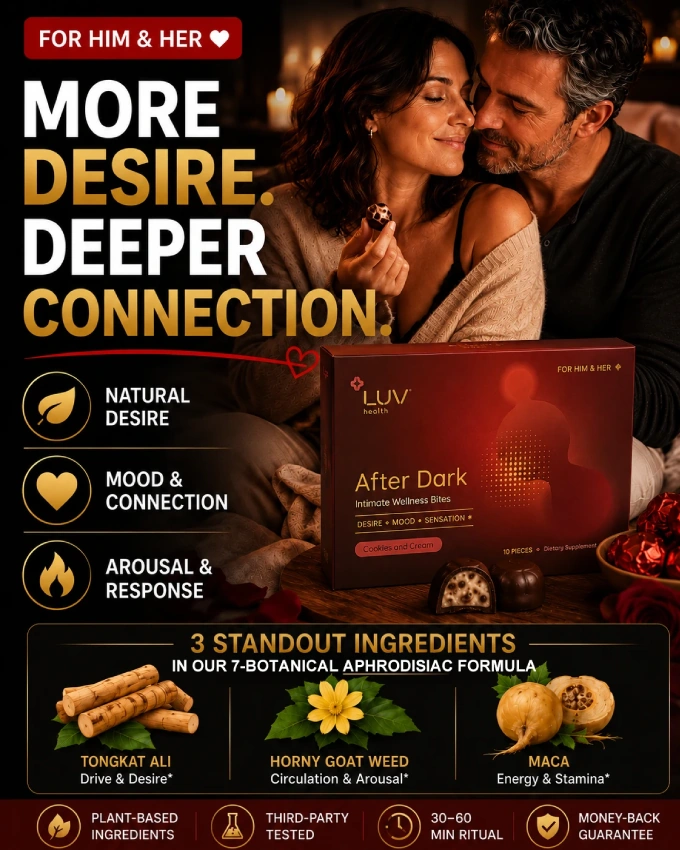
Eight Botanicals, One Shared Chocolate — Built for the Stress-and-Rut Causes
4.8/5 · 2,600+ verified reviews · 41,000+ couples
For the everyday drivers of a flat sex drive — stress, disconnection, the routine that ate the romance — LUV After Dark packs the researched botanical shortlist (Maca, Tongkat Ali, Damiana, Mucuna Pruriens, Tribulus, Horny Goat Weed, Kava, Theobromine) into a Cookies & Cream chocolate both partners share.* No hormones, no stimulants, a full 150mg-blend piece for each of you — the formula and the ritual in one bite.
Why "risk-free" isn't marketing air here: every official-store order carries the 120-day "LUV It or Leave It" money-back guarantee — longer than the 2–6 weeks the botanicals need — with a full refund even on empty boxes. Bundle savings and Subscribe & Save (20% off + every 4th box free) at the official store, shipped in plain packaging.
Try LUV After Dark Risk-Free120-day money-back guarantee · Discreet shipping from San Diego
The Rut Is the Most Fixable Cause on the Map
One chocolate each at dinner, 120 days to judge — full refund if your evenings don't change.
Try LUV After Dark Risk-Free