The Women's Guide
Low Sex Drive in Women: What's Actually Going On
Female low sex drive is the most-searched and worst-answered corner of this topic — usually met with either "it's all hormones" or "just schedule date night." The truth has more moving parts, and more fixable ones.
Who's behind this guide: lowsexdrives.com is owned and operated by LUV Health, maker of LUV After Dark intimacy chocolates — our recommended product is our own, so weigh our pick accordingly. What we won't bend for the sale: the cause map below includes the medical and medication causes a chocolate can't touch, and where the honest answer is "talk to a doctor," we say exactly that.
Start With How Female Desire Works
For most women, desire is responsive rather than spontaneous — it tends to arrive after the right conditions (safety, connection, anticipation, an unloaded mind), not before them. This single fact reframes most "low libido in women" worries: a responsive system in a context that never triggers it isn't broken — it's accurately reporting that the conditions aren't there. Which is why the causes below are dominated by context, not chemistry.
The Big Five Everyday Causes
1. The cortisol gate. Stress hormones actively suppress the desire cascade — and the mental load most women carry (the household's project manager role) keeps cortisol elevated in exactly the evening hours desire would need. 2. Exhaustion. Desire is a luxury function; a body running on sleep debt deprioritizes it ruthlessly. 3. The roommate drift. Co-managing a life is intimacy's quiet competitor — when every interaction is logistics, the erotic channel closes from disuse. 4. Body and mind elsewhere. Feeling unattractive, distracted, or watched-from-inside kills responsive desire at the gate. 5. Resentment with a lid on it. Unresolved friction is the least discussed and most common suppressant — desire struggles to coexist with a running mental ledger.
The Medication & Life-Stage Causes
Two medication classes deserve special mention because they're so common: SSRIs/SNRIs (libido effects are among their most-reported side effects) and hormonal birth control (a meaningful minority of users report dampened desire). If your timeline matches either, talk to the prescriber — adjustments exist, and this isn't a supplement problem. Life stages matter too: postpartum (hormones, healing, and a new human who owns your nights) and perimenopause (shifting estrogen and testosterone) both commonly move desire — normal in kind, worth a clinician's eyes if severe or paired with other symptoms.
When this is a doctor conversation, not a shopping decision
If low desire is persistent, distressing, or a sharp change from your normal — or arrived alongside a new medication, pain with intimacy, or symptoms like fatigue, low mood, or cycle changes — start with a clinician, not a supplement. Persistent low desire that causes distress is a recognized, treatable medical situation (clinicians call it HSDD), medication side effects can often be adjusted, and conditions like thyroid issues or depression deserve real diagnosis. Supplements support normal desire; they do not treat medical conditions — and the fastest fix for a medical cause is medical.
What Helps for the Everyday Causes
The pattern behind everything that works: lower the stress gate, rebuild anticipation, and support the desire systems underneath. Practically — a protected evening that isn't negotiable, devices out of the bedroom, the friction conversation you've been not-having, and movement that reconnects you with your body. On the support side, the botanicals with women-specific evidence target exactly the systems above: Maca and Tribulus for desire itself, Damiana and Kava for the stress gate, Mucuna for the dopamine "wanting" chemistry, Horny Goat Weed and Theobromine for the circulation side.* The catch — and the reason capsule regimens fail here — is that responsive desire needs the context too. A shared ritual delivers the context; the botanicals ride along.* That's the design of our pick, and the 120-day guarantee makes trying it genuinely risk-free: the full enhancer comparison or the offer below.
For the Everyday Causes · Try It Risk-Free
The 120-Day Test Drive: LUV After Dark
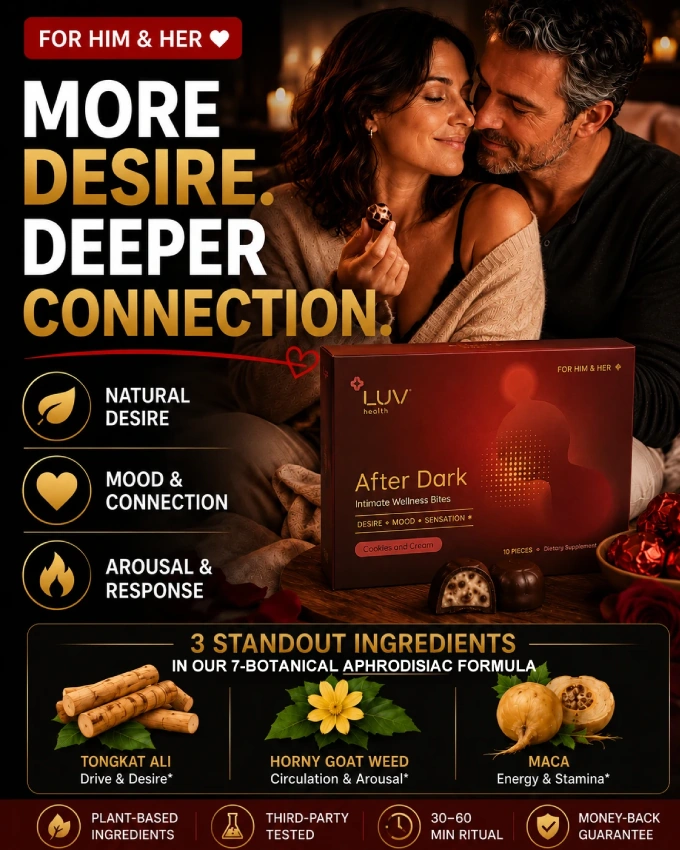
Eight Botanicals, One Shared Chocolate — Built for the Stress-and-Rut Causes
4.8/5 · 2,600+ verified reviews · 41,000+ couples
For the everyday drivers of a flat sex drive — stress, disconnection, the routine that ate the romance — LUV After Dark packs the researched botanical shortlist (Maca, Tongkat Ali, Damiana, Mucuna Pruriens, Tribulus, Horny Goat Weed, Kava, Theobromine) into a Cookies & Cream chocolate both partners share.* No hormones, no stimulants, a full 150mg-blend piece for each of you — the formula and the ritual in one bite.
Why "risk-free" isn't marketing air here: every official-store order carries the 120-day "LUV It or Leave It" money-back guarantee — longer than the 2–6 weeks the botanicals need — with a full refund even on empty boxes. Bundle savings and Subscribe & Save (20% off + every 4th box free) at the official store, shipped in plain packaging.
Try LUV After Dark Risk-Free120-day money-back guarantee · Discreet shipping from San Diego
Responsive Desire Needs a Ritual, Not a Prescription for Being Human
The botanicals and the ritual in one shared chocolate — 120 days to see what changes.
Try LUV After Dark Risk-Free